

Molecules

Clean molecules trajectories and energy system-wide consequences
Setting the scene
Wat are clean molecules?
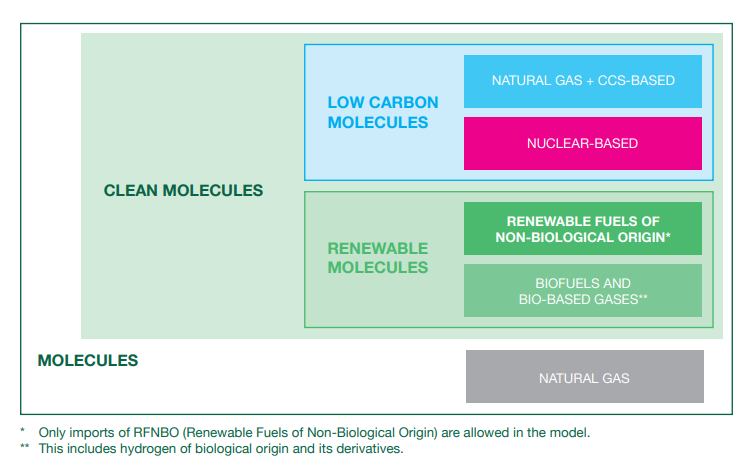
The study considers a range of molecules that may play a role in the Belgian energy system, as illustrated in Figure 1. The primary focus is on clean molecules, more specifically:
For domestic production: (i) Renewable Fuels of Non-Biological Origin (RFNBO) — i.e. renewable hydrogen and its derivatives (e.g. ammonia, kerosene, methane, methanol); (ii) low-carbon hydrogen (e.g. blue and pink) and their derivatives; and (iii) biofuels and bio-based gases.
For imports: the focus is on RFNBO hydrogen and its derivatives1.
Clean molecules are increasingly seen as a key pillar of the decarbonisation strategy in Europe and Belgium. They play a critical role in the energy transition by providing solutions for sectors where direct electrification is technically difficult or economically inefficient, such as high-temperature industrial processes (e.g. steel, chemicals, cement) and long-distance transport like aviation and maritime shipping. In addition, clean molecules enable the storage, transport, and international trade of renewable energy in chemical form, helping to balance energy systems with high shares of variable renewables.
What is the current strategic policy landscape for clean molecules?
RED III2 and the broader EU policy framework provide the foundation for Belgium’s energy transition by setting ambitious renewable energy targets, accelerating electrification, and promoting renewable hydrogen—particularly within industrial clusters and port areas. A key molecule-related target is the achievement of a 60% share of RFNBOs in industrial hydrogen consumption by 2050. In parallel, sector-specific regulations such as ReFuelEU Aviation and FuelEU Maritime drive the uptake of sustainable fuels—including e-kerosene in aviation and ammonia or e-methane in shipping. This transition is further supported by enabling market frameworks, infrastructure development, and economic instruments such as the EU ETS, the Carbon Border Adjustment Mechanism (CBAM), and dedicated public funding schemes.
In Belgium, there is no overarching, coordinated policy framework covering the full spectrum of clean molecules (e.g. ammonia, methanol, e-fuels, biomolecules). The Federal Hydrogen Strategy, updated in 2022, primarily positions Belgium as a key import and transit hub, with a strong focus on large-scale hydrogen imports, infrastructure development, and the creation of a supportive regulatory and market environment, while domestic production is expected to remain relatively limited. While the Belgian hydrogen strategy explicitly considers hydrogen derivatives—particularly in the context of imports and market development—it does not define dedicated quantitative targets for these. Instead, targets are framed at the level of overall hydrogen and hydrogen carrier volumes, infrastructure deployment, and market creation.
What are current challenges?
Belgium is making progress in governance, planning, and infrastructure development, with regulatory frameworks under preparation and the first elements of a hydrogen transport backbone beginning to materialise3 (FPS Economy, 2024). However, delays related to network development persist4, and progress on domestic production remains limited. To date, only around 25 MW is under construction, notably through the HyoffWind project (WaterstofNet, 2025).
Increasing evidence points to a potential misalignment between current EU policy frameworks and system-level requirements for timely and cost-effective scale-up of clean hydrogen supply as current frameworks heavily prioritise RFNBO hydrogen while giving limited consideration to potentially more cost-competitive, low-carbon alternatives, such as Carbon Capture and Storage (CCS) enabled hydrogen, particularly in the near to medium term (CREG, 2024; ACER, 2025). This may slow down large-scale hydrogen deployment, whereas a more technology-inclusive approach could accelerate market uptake, reduce system costs, and support the timely development of hydrogen infrastructure (Hydrogen Council, 2024).
At the same time, market demand remains uncertain, particularly among large industrial off-takers5 who would be expected to anchor early hydrogen markets. The absence of firm long-term purchase commitments and the still-significant cost gap between renewable hydrogen and conventional alternatives are slowing commercial deployment and projects’ scale-up. This uncertainty of demand risks delaying investment decisions across the value chain, including production, infrastructure, and import facilities (CREG, 2024; IEA, 2024; ACER, 2025).
Scope of the work
Hydrogen and its derivatives do not evolve in isolation, but as integral components of a broader energy system. Their deployment should therefore be evaluated through a system-wide cost optimisation lens, considering how they interact with alternative decarbonisation pathways such as bioenergy and CCS. Assessing these interactions and trade-offs is essential to determine where hydrogen delivers the greatest value and to identify robust, cost-effective decarbonisation strategies. At the same time, cost optimisation alone does not fully determine the preferred pathway —strategic considerations such as energy independence, security of supply and resilience can significantly influence outcomes and should be explicitly considered.
Given the emerging gaps between expectations, current policy constraints and practical deployment challenges, a deeper assessment of the 60% renewable hydrogen requirement under RED III was developed to better inform future molecule-oriented strategies. These insights were complemented with an indicative assessment of the transitional role of other energy carriers, the role of CCS and specific applications of clean molecules. This all results in recommendations for future strategy development.
KEY TAKEAWAYS
-
Hard-to-electrify sectors
Prioritise clean molecules for aviation, maritime, and heavy industry
Not for road transport, buildings, or low-temperature heat.

-
Mix of molecules
Support mix of hydrogen (green/blue), biofuels, synthetic fuels, CCS-based Natural Gas
Despite its key role in derivatives, hydrogen accounts for only 5% of final energy demand and 15–25% of clean molecule use.

-
Domestic hydrogen production
Relaxing hydrogen regulatory requirements increases domestic hydrogen production to 22.3 TWh via SMR/ATR with CCS
with annual cost savings of around €250M per year by 2050

-
60% renewable hydrogen requirement
implies high clean molecule imports and limited domestic production

What is the solution space of clean molecules under current policy frameworks and the 60% renewable hydrogen requirement?
This section provides the key messages of the PATHS2050 results (2025 Edition) for Belgian molecule trajectories under the scope of identifying the impact of current policy frameworks. Table 1 provides data on the Belgian clean molecules supply in 2050 for the three main scenarios. The Sankey Diagram shown in Figure 2 is a representative illustration across all analyzed scenarios.
SCENARIO | |||
| Molecules - Supply | ROTORS | REACTORS | IMPORTS |
| Hydrogen | |||
Import (TWh) | 17 | 2 | 6 |
Domestic production (TWh) | 11 | 9 | 10 |
| Ammonia (feedstock) | |||
Import (TWh) | 6 | 6 | 6 |
Domestic production (TWh) | 0 | 0 | 0 |
| Ammonia (energy) | |||
Import (TWh) | 0 | 2 | 9 |
Domestic production (TWh) | 0 | 0 | 0 |
| Synthetic Methane | |||
Import (TWh) | 34 | 40 | 58 |
Domestic production (TWh) | 0 | 0 | 0 |
| Synthetic Kerosene | |||
Import (TWh) | 13 | 15 | 15 |
Domestic production (TWh) | 0 | 0 | 0 |
| Methanol | |||
Import (TWh) | 0 | 0 | 0 |
Domestic production (TWh) | 14 | 2 | 0 |
| Total for energy (TWh) | 95 | 76 | 104 |
| Import share | 74% | 86% | 90% |
Table 1. Belgian clean molecules supply in 2050 for the ROTORS, REACTORS and IMPORTS PATHS2050 scenarios.
The Sankey diagram below visualizes the molecule flows in 2050 from supply sources to final energy and feedstock demand across the analyzed scenarios.
The width of each flow is proportional to the corresponding energy volume (TWh), allowing a quick identification of the dominant import streams and end-use sectors.
Users can switch between the different scenarios by clicking on the scenario names shown at the bottom of the chart.
Figure 2: Molecule flows (TWh) from supply sources to end-use demand
“ Electricity generation scarcity and current hydrogen requirements drive Belgium toward import-based clean molecules ”
On the one hand, structural constraints—such as limited renewable potential and high electricity prices— undermine the competitiveness of large-scale domestic Power-to-X. On the other hand, current regulatory frameworks, particularly RED III, further reinforce this dynamic. Stringent criteria for RFNBO hydrogen increase production costs, by limiting the use of more cost-competitive pathways such as blue hydrogen (SMR/ATR with CCS) and reducing operational flexibility. As a result, domestic production is confined to a small amount of renewable hydrogen.These trends are illustrated by the different system outcomes across scenarios. In REACTORS, binding RED III targets and high marginal costs of RFNBO hydrogen lead to overall limited hydrogen deployment. In ROTORS, renewable hydrogen is indirectly promoted due to constraints on CO₂ storage and the need for carbon utilisation pathways to tackle emissions. Due to cost disadvantages of RFNBO hydrogen and limits on blue hydrogen eligibility, domestic scale-up remains limited.
Consequently, the business case for scaling domestic clean-molecule production is weakened and Belgium’s energy system increasingly relies on imported hydrogen derivatives—such as e-ammonia, e-methane, and e-kerosene—as the dominant supply pathway, creating external dependencies.
“ Electrification leads, but a smart mix of molecules—fossil, bio-based, and synthetic—fills the gaps where it matters most ”
The energy transition is driven by electrification and efficiency, with molecules playing a key targeted and complementary role. Fossil fuels—particularly natural gas—decline sharply but still account for around 10–15% of final energy use by 2050, primarily in high-temperature in energy-intensive industrial processes and for system flexibility through dispatchable power generation and balancing services. In these applications, they are increasingly coupled with CCS or replaced by clean molecules (see executive summary on CCUS).
Clean molecules—both bio-based and RFNBO—complement electrification in sectors that are difficult to electrify, including international transport and heavy industry (e.g. steel, chemicals, and copper), all of which require high energy density fuels or carbon-based feedstocks. Additionally, a small fraction is used for power production. Overall, bio-based molecules provide complementary support to synthetic molecules, accounting for around 5% of final energy consumption by 2050. Biomethane is primarily used in maritime transport, helping to mitigate the higher costs of e-methane, while solid biomass supports industrial applications and CHP generation. If prioritised, biomethane could play a transitional role in hard-to-electrify sectors. For instance, If more biomethane were available, heating buildings in large cities could be achieved without the need to roll out district heating networks. When combined with CCS, biomass can deliver net-negative emissions. When looking to RFNBO, e-methane followed by e-kerosene are the largest-volume molecules and mainly applied in maritime transport replacing fossil natural gas, and in aviation respectively. It should be noted that international transport is typically excluded from national greenhouse gas accounting, and therefore does not directly translate into domestic emissions reductions.
What are the impacts on clean molecules trajectories by relaxing the current 60% hydrogen regulatory requirements?
Given the limitations associated with current hydrogen regulatory requirements, a dedicated assessment builds on the REACTORS scenario as a baseline, which already incorporates a limited share of low-carbon hydrogen produced via ATR and SMR. It examines an alternative configuration in which regulatory constraints on hydrogen production are relaxed, enabling a higher share of low-carbon hydrogen to enter the supply mix. This approach enables an evaluation of how reduced regulatory barriers could influence deployment levels and facilitate early market development. The main results are presented in Table 2. For a graphical representation, please refer to the Sankey diagram in Figure 2 and select the rightmost scenario in the filter section at the bottom of the chart.
SCENARIO | ||
| Hydrogen requirements | REACTORS | REACTORS with relaxation of regulatory hydrogen requirements |
| Production | ||
H2 domestic from SMR + ATR (TWh) | 2 | 22 |
H2 domestic other (TWh) | 8 | 8 |
H2 Imports (TWh) | 2 | 0 |
| Consumption | ||
H2 in Steel (TWh) | 0 | 11 |
H2 in Chemical Sector (TWh) | 0 | 3 |
H2 for ammonia for navigation (TWh) | 0 | 4 |
| Total system costs | ||
Reduced import costs (MEUR/a) | / | 750 |
Additional costs (Investments – annualized + fixed operational) (MEUR/a) | / | 500 |
| Overall savings (MEUR/a) | / | 250 |
Table 2. Comparison of Hydrogen supply and use as well as overall costs in the REACTORS scenario and the Relaxation assessment in 2050.
Relaxing regulatory hydrogen requirements reshapes the REACTORS scenario by shifting the system towards domestic, cost-driven hydrogen production and use. Blue hydrogen—produced via SMR/ATR with CCS— becomes the dominant hydrogen production pathway increasing to approximately 6 TWh by 2040 and 22 TWh by 2050 for domestic consumption, while imports decline to nearly zero. This transition is enabled by the removal of regulatory constraints and results in a system that is less dependent on international supply and price volatility.
At the same time, the availability of this lower-cost hydrogen unlocks substantial new demand in hard-to-electrify industrial sectors. Hydrogen use expands significantly in steel (0 → 11 TWh), particularly through DRI processes, and increases in the chemical sector (3 → 6 TWh). This illustrates that hydrogen demand is highly price-sensitive and scales when cost conditions improve and policy enables so.
As a result, hydrogen shifts from playing a limited, niche role in the baseline REACTORS scenario to becoming a structural component of industrial decarbonisation, especially in heavy industry. This highlights that policy design is a decisive factor: regulatory constraints do not just influence volumes at the margin but determine whether hydrogen remains peripheral or becomes system-critical.
This transformation, however, comes with a strategic trade-off. Increased domestic production requires higher upfront investments and a strong reliance on CCS infrastructure. In return, the system benefits from reduced import dependency, greater resilience, and improved system cost efficiency. Indeed, the results show that relaxing regulatory constraints lowers overall system costs while strengthening industrial competitiveness.
Crucially, this pathway hinges on the availability and scaling of CCS, as blue hydrogen becomes the backbone of the system, accounting for most of the supply. This underscores that hydrogen and CCS policies are deeply interconnected: enabling one effectively requires enabling the other.
The impact of the regulation relaxation is marginal on other molecules with a slight decrease in imported e-methane (from 40 to 37 TWh), a slight decrease in imported ammonia (8 to 6.1 TWh).
“ Current regulatory hydrogen requirements restrict the potential for extensive locally produced hydrogen use in industry. A relaxation or revision of these constraints could enable blue hydrogen to become key feedstock for the chemical sector as from 2035 and as a key energy carrier for the steel sector as from 2040 ”
Under current regulatory hydrogen requirements, the high production costs of RFNBO hydrogen limit large-scale uptake, while more cost-competitive blue hydrogen pathways remain constrained due to strict regulatory definitions and sustainability criteria. This prevents investments in SMR/ATR with CCS despite their technological readiness and prevents industrial sectors - such as steel and chemicals - from accessing the large stable and affordable hydrogen volumes they require, thereby hindering the scale-up of hydrogen-based decarbonisation pathways.
Blue hydrogen remains a potential option for supplying high-temperature heat in the chemical sector. This could help chemical companies avoid the relatively high capital and operational costs of CCS faced by smaller firms. However, in 2050, the use of blue hydrogen is constrained by residual emissions. Expanding its application to additional end uses would therefore reduce its availability for sectors such as steel and is therefore not selected for heat in the chemical sector.
“ Relaxing regulatory hydrogen requirements in industry yields cost savings of around 250 MEUR per year by 2050 ”
Relaxing hydrogen requirements and enabling CCS deployment reshapes Belgium’s 2050 energy system. Hydrogen production shifts to natural gas-based ATR, reaching up to 3 GW (hydrogen output). While these installations entail annualized costs of approximately €0.5 billion, they reduce import costs by €0.75 billion, even accounting for additional natural gas consumption. As a result, imports of clean molecules decline by 7 TWh and costs savings of around 250 MEUR are achieved.
Before 2045, blue hydrogen amounts to 1 GW capacity and is primarily used in petrochemicals, including refinery feedstocks and ammonia production, with limited use of hydrogen in the power sector to provide system flexibility. Blue hydrogen is a viable option before 2045 but does not deliver significant cost reductions in this period. Three factors explain this: biomethane and biomass already play a substantial role by 2040; on-site CCS in industry offers lower-cost abatement with acceptable residual emissions; and hydrogen infrastructure remains a hurdle.
Policy recommendations - What insights from PATHS 2050 modelling can inform future strategy building?
Based on the PATHS2050 modelling, the following policy recommendations can guide future strategy development:
Support a mix of molecules—hydrogen (green/blue), biofuels, synthetic fuels; prevent reliance on a single pathway.
Consider technological neutrality for hydrogen supply - ground Belgium’s hydrogen policy in realistic cost and system constraints, and apply regulatory flexibility (via EU implementation or changes to EU regulations) to enable domestic low-carbon hydrogen production. This supports mid-term industrial emission reduction and facilitates early-stage derisking of the required CO₂ and H₂ infrastructure.
Make CCS an early priority - by accelerating CO₂ transport/storage and cross-border value chains; treat CCS as complementary to domestically produced hydrogen (see executive summary on CCUS).
Shift from a “hydrogen-first” approach to system optimization - prioritize clean molecules only in cost-effective sectors like steel, chemicals, high-temp heat, aviation and shipping; avoid excessive use where electrification works. This implies that they are not expected to play a significant role in sectors where direct electrification is more efficient, such as road transport, buildings and low-temperature industrial heat.
Supported by other studies, we also derive the following insights:
Plan infrastructure for integrated molecule systems - ammonia cracking, hydrogen and CO2 networks, methane networks (repurpose gas grids), port-based conversion hubs- to enable carrier flexibility.
Prioritize demand creation, for instance, by using Contracts for difference and long-term supply agreements, to drive industrial uptake; focus on demand signals over capacity targets.
Manage import dependency: diversify sources/carriers, build strategic partnerships and monitor price volatility.
References
ACER. (2025). European hydrogen markets – 2025 monitoring report. Retrieved from
https://www.acer.europa.eu/sites/default/files/documents/Publications/ACER-2025-European-hydrogen-markets.pdf
Argus Media. (2025a, April 17). Belgian H2 pipeline faces year delay in fruit dispute. Argus Media. Retrieved from
https://www.argusmedia.com/en/news-and-insights/latest-market-news/2679505-belgian-h2-pipeline-faces-year-delay-in-fruit-dispute
Argus Media. (2025b, June 20). ArcelorMittal halts DRI-EAF projects in the EU. Argus Media. Retrieved from
https://www.argusmedia.com/en/news-and-insights/latest-market-news/2701298-arcelormittal-halts-dri-eaf-projects-in-the-eu
Clean Hydrogen Partnership. (2024). The European hydrogen market landscape: November 2024. Retrieved from
https://observatory.clean-hydrogen.europa.eu/sites/default/files/2024-11/The%20European%20hydrogen%20market%20landscape_November%202024.pdf
CREG. (2024). Uncertain development of the hydrogen market: How to overcome the challenges ahead. Retrieved from
https://www.creg.be/sites/default/files/assets/Publications/Studies/F2761EN.pdf
European Court of Auditors. (2024). The EU’s hydrogen strategy: Targets at risk. Retrieved from
https://www.eca.europa.eu/ECAPublications/SR-2024-11/SR-2024-11_EN.pdf
Hydrogen Council. (2024). Hydrogen insights 2024.
https://hydrogencouncil.com/en/hydrogen-insights-2024/
Fluxys. (2025, December 3). HY4Link hydrogen corridor awarded EU project of common interest status. Retrieved from
https://www.fluxys.com/en/press-releases/fluxys-hydrogen/2025/251128-press-hy4link-hydrogen-corridor-awarded-project-of-common-interest-status
FPS (Federal Public Service) Economy. (2024). Belgian federal hydrogen strategy. Retrieved from
https://economie.fgov.be/en/themes/energy/sources-and-carriers-energy/hydrogen/belgian-federal-hydrogen
International Energy Agency. (2024). Global hydrogen review 2024. International Energy Agency.
https://www.iea.org/reports/global-hydrogen-review-2024
WaterstofNet. (2025, February 20). Hyoffwind starts construction – Belgium’s first 25 MW green hydrogen plant in the Port of Antwerp-Bruges.
https://www.waterstofnet.eu/en/news/hyoffwind-starts-construction-belgium-s-first-25-mw-green-hydrogen-plant-in-the-port-of-antwerp-bruges/
ACER. (2025). European hydrogen markets – 2025 monitoring report. Retrieved from
https://www.acer.europa.eu/sites/default/files/documents/Publications/ACER-2025-European-hydrogen-markets.pdf
Argus Media. (2025a, April 17). Belgian H2 pipeline faces year delay in fruit dispute. Argus Media. Retrieved from
https://www.argusmedia.com/en/news-and-insights/latest-market-news/2679505-belgian-h2-pipeline-faces-year-delay-in-fruit-dispute
Argus Media. (2025b, June 20). ArcelorMittal halts DRI-EAF projects in the EU. Argus Media. Retrieved from
https://www.argusmedia.com/en/news-and-insights/latest-market-news/2701298-arcelormittal-halts-dri-eaf-projects-in-the-eu
Clean Hydrogen Partnership. (2024). The European hydrogen market landscape: November 2024. Retrieved from
https://observatory.clean-hydrogen.europa.eu/sites/default/files/2024-11/The%20European%20hydrogen%20market%20landscape_November%202024.pdf
CREG. (2024). Uncertain development of the hydrogen market: How to overcome the challenges ahead. Retrieved from
https://www.creg.be/sites/default/files/assets/Publications/Studies/F2761EN.pdf
European Court of Auditors. (2024). The EU’s hydrogen strategy: Targets at risk. Retrieved from
https://www.eca.europa.eu/ECAPublications/SR-2024-11/SR-2024-11_EN.pdf
Hydrogen Council. (2024). Hydrogen insights 2024.
https://hydrogencouncil.com/en/hydrogen-insights-2024/
Fluxys. (2025, December 3). HY4Link hydrogen corridor awarded EU project of common interest status. Retrieved from
https://www.fluxys.com/en/press-releases/fluxys-hydrogen/2025/251128-press-hy4link-hydrogen-corridor-awarded-project-of-common-interest-status
FPS (Federal Public Service) Economy. (2024). Belgian federal hydrogen strategy. Retrieved from
https://economie.fgov.be/en/themes/energy/sources-and-carriers-energy/hydrogen/belgian-federal-hydrogen
International Energy Agency. (2024). Global hydrogen review 2024. International Energy Agency.
https://www.iea.org/reports/global-hydrogen-review-2024
WaterstofNet. (2025, February 20). Hyoffwind starts construction – Belgium’s first 25 MW green hydrogen plant in the Port of Antwerp-Bruges.
https://www.waterstofnet.eu/en/news/hyoffwind-starts-construction-belgium-s-first-25-mw-green-hydrogen-plant-in-the-port-of-antwerp-bruges/